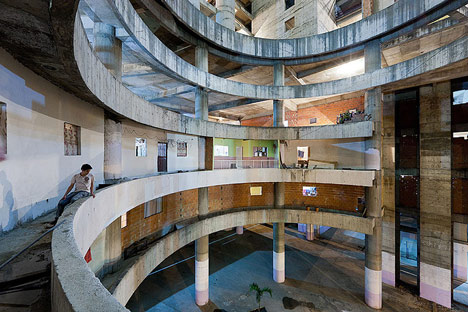
A banking tower in Venezuela has become home to 750 families who have adapted and adopted the abandoned offices from the 1990s.
via dezeen
"It should never have happened it was an accident" Curator, Justin McGuirk
"It's the domino house...a hybrid, a fascinating structure"
[Phenomena of Transition. read full text by Soranart Sinuraibhan at othermarkets]
[...] There is no definite entrance to Rom-Hoob market. People can, and do, access it at the beginning of the market (next to Mae-Klong station) or through small passageways which are situated at oblique angles through the market and connect the main road with the central market. All stalls are set up next to the railway track with out-stretching sun-shades that informally establish a defined corridor through the whole market. The track is then transformed in this manner into a footpath. The sun-shade is simply improvised from a tent sheet, ropes, a bamboo pole, a steel post and whatever else locals can find at the site. The entire structure is simply designed and constructed by locals. It is easy to operate and can be collapsed by just one to two people. After assembly, the tent sheet can be stretched out up to 2 meters in length and lifted up to 2-3 meters high. Interestingly, the sun-shade attached to each stall and its stands are designed to be able to close and move each time the train passes through (6 times daily).
Through critical examination of each stall, the relationship between the everyday architecture (occupied by its inhabitants) and the flows of space is revealed. The stalls can be categorized into several forms according to different foods and products. Vegetables and fruits are put in baskets and placed next to or immediately on top of the track. There is no need to move these baskets when the train comes as the space between the wheels allows it to pass completely over the baskets. Seafood, chili paste, or light weight products are laid on small tables, which are readily assembled from a piece of wood and metal stands. These can be easily dismantled, lifted up and moved. Heavier products, such as meats or household items, are placed on bigger and stronger stainless-steel tables with wheels attached. These tables are custom made and come in different sizes. They can slide in and out when the train passes through and are simply operated by hand. Most sellers, however, prefer to sit on the floor or existing railings, as in one view, it is more convenient and easier to move when the train comes.