Thursday, 1 September 2011

More on Berlin plight of the yuppies; Cars on Fire


(To read more click on image below, article via decontre )

"After two intense weeks of cars being set on fire at night in the streets of Berlin, yesterday was calm again. Since January 2011 more than 530 cars have burnt, but the pyromaniac series has been going on for 4 years now. And there is still no clue for the actual reasons behind the incendiary crimes: youngster vandalism, cheating insurance companies or straight discontent among Berlin citizens.
[...]
The more gentrified these neighbourhoods have become; the more social protests have broken out in the past 5 years. Collision in public space usually has a political background. Graffiti against Mieterhöhung (Rent increase) and Yuppies (specially from wealthy Southwest Germany) are to be found on many façades.
[...]
Gentrification is still a double-edged weapon. Contingents of Turkish people among others were invited to immigrate and raise a city in ruins in past decades, but their city seems not to need them anymore. Obviously for Chancellor Merkel, multicultural society has utterly failed (“Multi-Kulti hat ausgedient”). But there is rage against the machinery.


Conclusion Sofa


'Conclusion Sofa' by Studio Mazem via designboom.com

Wednesday, 31 August 2011

David Galbraith's is all I need

This blog is going to make a big difference to my next year of architecture. http://davidgalbraith.org/
How handy would this post about breathability have been on my last tech exam. the answer - very.


"Doing some architecture again (renovating this) after fifteen years is making me look at it with a fresh eye.

For example, there is a big problem with green building terminology, it often says the opposite of what it means and many architects seem to have misunderstood the design issues because the terminology is misleading. As an example of the lunacy in terminology, in the context of building materials (and clothing), breathable usually means airtight. This often makes things hard to understand, but the design concepts are actually straightforward and I’ll try and decipher some of them here.

Most of the innovation of the last 15 years is mirrored in the modern technology used in sports clothing and most of what there is to be understood about architectural innovation, such as breathing and composite materials can be understood from the design of decent modern shoes.

Once you’ve got a building to stand up, you want to: (a) avoid water getting in by flowing, but (b) let water vapor (sweat and steam) get out by soaking and then evaporating and (c) not let too much heat to get in or out via conductance or draft."

read rest via http://davidgalbraith.org

The Robbers Cave Experiment

via http://kottke.org/
Years ago, before this type of activity was frowned upon, scientists sent 2 groups of 11 and 12 year-old boys to live in separate sections of an Eastern Oklahoma camp. The boys didn't know about each other at first, and they quickly developed independent social hierarchies and social codes. One group named themselves the Rattlers. The other group didn't pick a name until after the groups discovered each other. They chose the Eagles, an animal that eats snakes. The scientists ratcheted up the competition between the two groups, eventually losing control of the experiment as the boys were executing violent raids on each others' camps. The scientists finally separated the camps before someone got killed, but not before documenting some interesting concepts of how groups form social norms and how they react to others they perceive as different.
This post could go on forever, so, when you have time, click through to read about realistic conflict theory and illusion of asymmetric insight.

Sunday, 21 August 2011

Room Installation, Jacob Hashimoto

via http://ofpaperandthings.blogspot.com/


Zaha Hadid London Aquatics Center 2012; Construction


The architectural concept of the London Aquatic Centre is inspired by the fluid geometries of water in motion, creating spaces and a surrounding environment that reflect the riverside landscapes of the Olympic Park. An undulating roof sweeps up from the ground as a wave – enclosing the pools of the Centre with a unifying gesture of fluidity, while also describing the volume of the swimming and diving pools.
The Aquatics Centre is designed with an inherent flexibility to accommodate 17,500 spectators for the London 2012 Games in ‘Olympic’ mode while also providing the optimum spectator capacity of 2000 for use in ‘Legacy’ mode after the Games.

To do


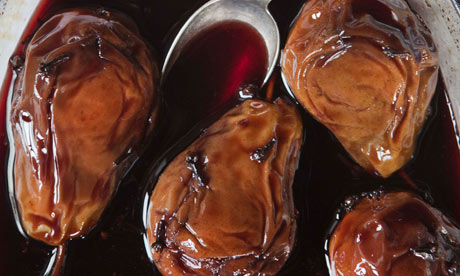
Pears baked in red wine and cloves (from Veneto)

pears baked in red wine and clovesPears baked in red wine and cloves.
At a little trattoria in Treviso, at the end of a resplendent meal, the waiter suggested baked pears. When a pair of small, wrinkled fruits arrived, unadorned on their plate, I was reassured by the perfume that he had recommended well. Pears cooked in red wine sound ordinary and uninteresting. But these are baked, with their skins on, in large quantities of wine, sugar and cloves until the syrup is thick, the fruit condensed and aromatic. Served cold, they are as perfect a conclusion to a meal as one could wish for.
Serves 4
firm-ish pears 2kg
caster sugar 750g
whole cloves 4g
red wine 1.5 litres
DIRECTIONS
Use a baking tin with deep sides into which the pears will fit in a single snug layer. Sprinkle with the sugar and cloves, then add the red wine, so that it rinses any sugar from the surface of the pears and comes just level with their tops. Bake in a hottish oven (180C/gas mark 4), with the heat coming mostly from below if your oven allows. Bake for around 2½-3 hours, turning only 2 or 3 times until the syrup is thick and the pears wrinkled – perhaps a few have split, and are slightly browned on top. Leave to cool, then serve at room temperature. I think these are perfect on their own, but if you yearn for an accompaniment, try mascarpone cream.
via the guardian